| Beadboard Moldings vs. Standard Beadboard: Which Is Right for Your Project? |
Beadboards can soften a flat wall, add depth to a ceiling, and give a room a crafted, finished feel without a major renovation. But once you specify it for a project, a practical question arises: do you choose beadboard moldings or stick with standard beadboard panels? The two look similar at a glance, yet behave very differently in fabrication, installation, and long-term wear.
This guide breaks down the real differences in appearance, installation, durability, and customization, then shows where each option performs best, whether detailing an accent wall, wrapping a ceiling, or adding trim character.
Beadboard Moldings vs. Standard Beadboard: A Comparison
Standard beadboard refers to the familiar panel: a flat sheet, often made of MDF, plywood, or PVC, milled with a repeating “bead and groove” pattern. It ships in large sheets or planks and covers broad surfaces, walls, wainscoting, and ceilings in continuous runs. Among interior beadboard products, it is the workhorse, the surface that fills a field.
Beadboard moldings are a different animal. These are the profiled, dimensional trim members, the caps, rails, edges, and transition pieces that frame and finish a beadboard installation or carry the bead detail into a smaller decorative element.
Where a standard panel fills a field, a molding defines an edge, conceals a seam, or wraps a contour. Both use the same bead pattern, but one is a surface pattern and the other a profile pattern.
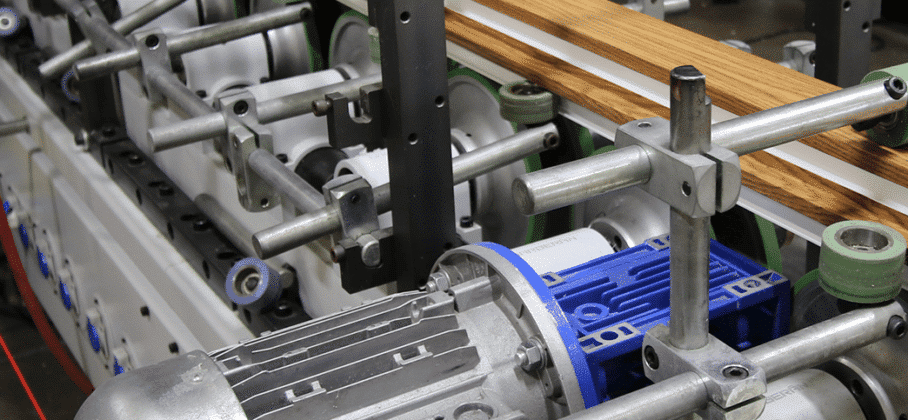
That distinction matters most at manufacturing. A dimensional profile must be finished cleanly on every face and radius, which is where profile wrapping services come in.
Appearance: Field Coverage vs. Crafted Detail
Standard beadboard delivers rhythm. The evenly spaced beads draw the eye across a surface and create a calm, repeating texture that works well on large planes. As decorative wall panels go, it is the classic behind cottage walls and farmhouse ceilings, dependable, familiar, and easy to live with.
Moldings deliver definition. A profiled cap or edge gives a beadboard run a crisp, finished border instead of a raw cut line, and the dimensional shadow lines add a layer of architectural detail that a flat panel cannot produce on its own.
When you want a space to feel tailored rather than simply paneled, moldings do that work. In practice, the panel sets the field, and the molding closes it off.
Installation: Coverage Speed vs. Precision Detailing
Standard panels are built for efficiency. Large sheets cover the ground quickly, and tongue-and-groove planks fit snugly, keeping the bead pattern continuous. Once a level starting line is set, runs go up fast. The main planning task is mapping seams, outlet cutouts, and corners before the first board is installed to keep the pattern aligned.
Beadboard moldings are part of transitions, where a run terminates, where two surfaces meet, and where materials change. Clean miters and tight returns are what make the finished edge look professional.
These profiles also do real concealment work, covering expansion gaps at the ceiling, masking cut edges at corners, and giving the installer a forgiving, finished line to work to. Among beadboard trim options, the cap and base profiles carry the most visual weight in the finished room.
Durability: Where Long-Term Performance Is Won or Lost
This category determines whether a wall will still look new in 10 years. The biggest threat to any beadboard installation, panel or molding is moisture, since wood-based products swell, warp, and eventually peel when water reaches an unsealed edge.
The U.S. Consumer Product Safety Commission advises keeping indoor humidity below 50 percent to prevent moisture from condensing on building materials.
The same guide makes a second point: using polyurethane to reduce formaldehyde emissions from pressed-wood products such as beadboard. The coating must cover all surfaces and edges and remain intact to be effective.
That is where a fully wrapped profile outperforms a painted one. When a beadboard molding or panel is profile-wrapped, the decorative film bonds continuously around the contour, with no brushed-on coating to crack at the beads and no exposed grain to wick moisture.
Moldings also seal the vulnerable cut edges of a panel run. The trim becomes part of the moisture defense, not just decoration.
Customization: Coordinating Color, Finish, and Style
Customization is where wrapped beadboard opens up. Rather than committing to on-site painting, the finish is built into the product. Stealth Finishing wraps profiles in an extensive palette of solid colors, including White, Beige, Clay, Cocoa, Black Onyx, and Hunter Green, as well as realistic woodgrains such as Golden Oak, Walnut, Mahogany, American Cherry, and Vintage Pecan.
Because the same laminate applies to both the flat-panel field and trim profiles, a beadboard molding and its adjacent panel can carry an identical, repeatable finish with no batch-to-batch paint variation.
This holds an interior beadboard design together. A contemporary room can run a clean matte color from wall panel to cap, or a traditional space can carry a warm woodgrain through both field and trim. The look stays coordinated whether the piece is a broad ceiling panel or a slim edge profile, and it stays that way without hand-finishing each piece on a ladder.
Accent Walls, Ceilings & Trim: Beadboard Installation Ideas
Wall Molding Solutions
Lead with standard decorative wall panels to build the textured field, then frame the installation with beadboard moldings, a top cap, and a base edge to turn a paneled wall into a finished feature. The panel creates impact; the molding makes it look deliberate.
Ceilings
Panels are the natural choice for the broad ceiling plane, while beadboard moldings handle the perimeter transition where the ceiling meets the wall. On porch and covered-exterior ceilings, a moisture-resistant wrapped finish is especially valuable given the temperature and humidity swings those surfaces endure.
Beadboard Trim Options
This is the molding’s home turf. For wainscot caps, chair-rail transitions, edge details, and decorative accents, the profiled trim provides dimensional shadow lines and crisp edges that flat panels cannot. Here, the beadboard molding is the product, not the accent.
Matching the Interior Beadboard Design
For farmhouse and cottage interiors, generous panel coverage with simple moldings reinforces the classic look. For contemporary spaces, restrained use of panels with sleek, color-wrapped trim keeps detail clean. The pattern stays the same; the proportion of panel to molding sets the tone, and the right combination is among the most effective beadboard installation ideas for any style.
Choosing the Right Material for Your Conditions
Before settling on a look, settle on a material because the room dictates what will last. For dry interior spaces like a living room or hallway wainscot, MDF beadboard panels paired with MDF moldings give a flawless painted finish at a reasonable cost.
For kitchens, baths, mudrooms, and porch ceilings, lean toward PVC or another moisture-resistant core since those rooms are where bare wood and unsealed MDF tend to fail first.
For a stained, natural look, solid wood remains the choice, understanding it expands and contracts more with seasonal humidity. Matching the panel and molding core to each other and to the space’s conditions is the most reliable way to maintain the finish over the long term.
Because many beadboard moldings are made from MDF, it is worth knowing that the U.S. Environmental Protection Agency regulates formaldehyde emissions from composite wood products, including MDF, under its TSCA Title VI standards, and that compliant products are labeled accordingly, something to look for when specifying interior materials.
Bring Your Vision to Life with Stealth Finishing
Whether your project leans on broad standard beadboard panels, finely detailed beadboard moldings, or both, the finish deserves a partner who specializes in getting it right.
Stealth Finishing brings over 4 decades of profile-wrapping expertise, an extensive range of solid colors and realistic woodgrains, and finishes engineered to resist moisture and wear across interior and exterior applications.
Explore the full range of beadboard options, or reach out today to talk through the right finish for your next project.
FAQs
Do I need beadboard moldings, or can I install the panels on their own?
You can install panels alone, but the result usually looks unfinished, since a cap and base molding cover the raw edges and give the run a clean, intentional border.
Is beadboard suitable for bathrooms and other humid rooms?
Yes, if you choose a moisture-resistant core like PVC and seal all cut edges, because standard wood and unsealed MDF tend to swell where moisture reaches them.
What’s the difference between MDF beadboard panels and other materials?
MDF offers a very smooth, paint-ready surface at a lower cost but suits dry areas best, while solid wood and PVC handle moisture and humidity swings more reliably.
Why does a wrapped finish hold up better than paint?
A wrapped finish bonds a continuous film around the full profile and its edges, eliminating the cracking and peeling that on-site paint commonly develops on bead profiles over time.
Can the moldings and the panels be finished to match exactly?
Yes, because the same laminate library applies to both flat panels and profiled trim, the field and the moldings can carry an identical color or woodgrain.